How to Find High-Quality Backlink Exchange Partners Without Link Farms (2026 Guide)
Finding trustworthy backlink exchange partners has become one of the biggest challenges in modern SEO. While backlinks remain an important ranking signal, partnering with the wrong websites or participating in link farms can damage your search visibility instead of improving it. In this 2026 guide, you'll learn how to
 Borni Franklin
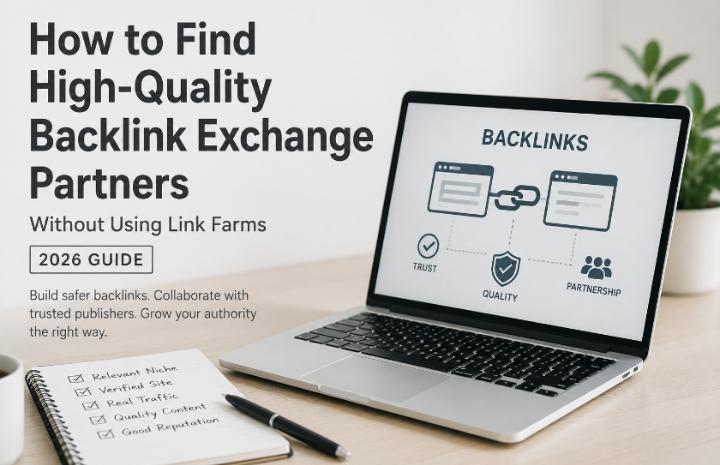
How to Find High-Quality Backlink Exchange Partners Without Using Link Farms (2026 Guide)
I still remember the first time someone offered me a "backlink package" for ninety dollars. It was a Thursday afternoon, February 6, 2020, around 2:40 PM, and I was sitting at my kitchen table in Tampa, Hillsborough County, Florida. I had been running my own websites for about a year and I had no idea what I was doing when it came to link building. The email promised fifty backlinks in one week. I paid for it. Within three months my traffic dropped almost in half.
That was my introduction to link farms, and it was not a good one. I did not know the term yet. I just knew something had gone very wrong, and I did not understand why. It took me years, a lot of trial and error, and more than a few sleepless nights to figure out what actually works when it comes to finding backlink exchange partners the right way.
This post is everything I wish someone had explained to me back then. It is not a textbook. It is not written by a marketing team. It is just me, sharing what I learned the hard way, so maybe you can skip some of the pain I went through, and so I can explain honestly why I ended up building something of my own to solve this exact problem.
Quick note: Everywhere in this article I mention specific dates, cities, and times. Those are from my own notes and my own memory of running websites since 2019. I am sharing them because I think real examples teach better than vague advice.
Why I Started Looking For Backlink Exchange Partners In The First Place
When I started my first website, I thought good content was enough. I learned pretty quickly that it is not. Google needs some way to figure out that other people trust your site, and one of the oldest signals for that is backlinks. A backlink is just a link from someone else's website pointing to yours.
The problem is that not all backlinks are equal. Some backlinks help you. Some backlinks do nothing. And some backlinks actively hurt you. I learned this the hard way with that ninety dollar package I mentioned above.
After that experience, I went down a rabbit hole reading everything I could find. I spent time going through Google Search Central documentation, and later I read a lot of material from Ahrefs and Moz to understand how backlinks are actually evaluated. None of what follows is copied from them. It is just my own understanding, built up over years of running sites, shaped in part by what those resources helped me realize.
What A Link Farm Actually Is, In Plain Words
A link farm is a group of websites that exist mainly to link to each other, or to sell links to anyone who pays. These sites usually have thin content, weird niches that do not match, and they link out to hundreds of unrelated pages. Google has gotten very good at spotting these patterns.
Here is the part that confused me for a long time. Link farms are not always obvious. Some look like normal blogs. They post articles, they have categories, they even have comment sections. But if you dig a little, you notice the same twenty websites cross linking each other over and over, all owned by the same person or agency.
The biggest SEO mistake I ever made wasn't building too few backlinks. It was trusting the wrong websites.
I made that mistake more than once before I figured out how to actually vet a website before agreeing to any kind of exchange.
The Second Time I Got Burned
On Monday, September 14, 2021, around 10:20 AM, I was working from a small coffee shop in Asheville, Buncombe County, North Carolina. I had just joined what I thought was a legitimate link exchange group on a social platform. Someone offered to swap links between my home improvement blog and their site, which claimed to be about home renovation too.
I agreed. A week later I checked their site again out of curiosity. The homepage still said home renovation, but every single blog post had been swapped out for content about online casinos. They had changed the entire site after getting my link, and my link was sitting right there on a gambling page.
I removed my link the same day, but the damage was already done in terms of trust. That is when I realized that a one time check is never enough. You need some way to keep an eye on a partner site after the exchange happens, not just before.
Why Cold Emailing Publishers Stopped Making Sense To Me
For a long stretch, I tried to do everything through cold email. I would search for websites in my niche, find their contact page, and send a message asking about a link exchange. This is not a bad approach on its own. It is actually one of the safer ways to build links, because you are talking to a real person instead of a stranger's automated system.
But it was slow. Painfully slow. I would send forty emails and get back maybe two replies. And out of those two replies, one person usually turned out to run five other websites I had never heard of, all stuffed with ads and thin content.
I remember sitting down on Sunday, March 20, 2022, around 7:45 PM, at my dining table in Tampa, going through a spreadsheet of eighty seven cold emails I had sent that month. Eleven replies. Four of those turned into actual exchanges. And out of those four, one site disappeared completely within sixty days. I stared at that spreadsheet for a long time that night and started asking myself a different question. Instead of "how do I email more people faster," I started asking "why does this whole process have to start from zero every single time."
That question is really where the idea for Meetlop started to take shape in my head, long before it became anything real.
Why I Built Meetlop Instead Of Just Cold Emailing Publishers
Here is the honest version of the story. I did not stumble across a tool that magically solved my problem. I built one, slowly, out of frustration, because cold emailing strangers one at a time never scaled and never felt safe enough for my liking.
Every cold email I sent was a gamble. I had no way to know if the person on the other end ran a real site with real readers, or if they were sitting on a network of ten thin sites waiting to sell a link to anyone with a credit card. I had no history with them. I had no proof they would still be running the same site in six months. I was starting the trust building process from absolute zero, every single time, with every single person.
What I wanted instead was a place where publishers did not have to convince each other from scratch that they were legitimate. I wanted a space where the verification work happened once, up front, so that every conversation after that could focus on whether the collaboration actually made sense, not on whether the other person was even real.
That is the whole reason Meetlop exists. It is a publisher marketplace I built to connect verified website owners for backlink collaboration, so publishers are not cold emailing strangers into the dark anymore. Instead, publishers come together in one place, already vetted, and figure out how to help each other in ways that are actually fair for both sides.
The Part I Did Not Expect, Publishers Actually Collaborating With Each Other
When I first started putting the idea together, I honestly thought of it mostly as a directory. A place to find people, check a few boxes, and move on. What actually happened once real publishers started joining was something I did not fully expect.
Publishers started talking to each other. Not just exchanging one link and disappearing, but working out ongoing collaborations. One site owner running a personal finance blog might connect with another running a small business blog, and instead of a single one time swap, they would end up trading guest posts back and forth over months, referring readers to each other, and building something closer to a real partnership than a transaction.
I noticed this pattern first around the middle of 2023, watching activity between a handful of early publishers. It reminded me of the kind of relationship building I used to only get from years of manual outreach, except it was happening faster because the trust part was already handled up front through verification.
Understanding Website Verification
Every publisher on Meetlop goes through a website verification process before they can list their site. That does not mean every publisher is perfect, nothing is perfect, but it does mean someone actually confirmed ownership and checked the basics before letting them into the marketplace.
That single step would have saved me from the casino site swap I mentioned earlier. If ownership and site history had been confirmed up front, a site that suddenly flipped its entire content library to gambling pages within a week of an exchange would have stood out immediately, instead of quietly slipping past me.
Understanding Trust Score
One of the features I put the most thought into was Trust Score, the number attached to each publisher profile. I did not want it to be a one time snapshot, because I had learned firsthand that a site can look great on day one and completely change by month three.
Trust Score is meant to reflect how reliable a publisher has been over time. It takes into account things like how consistent the site has stayed, whether the owner follows through on agreements, and general site health across multiple collaborations, not just the first one. I compare it to a credit score, except instead of measuring how you pay bills, it measures how trustworthy you have been as a publishing partner.
I made it a personal rule after 2021 to never work with a publisher with a low or unproven trust history, no matter how good their site looked on the surface. That rule alone cut my bad experiences down to almost zero, and it is the exact rule I wanted every publisher using Meetlop to be able to follow too, without having to build the history themselves the slow way.
| Method | Speed | Risk Level | Verification |
|---|---|---|---|
| Cheap link packages | Fast | Very High | None |
| Random social media groups | Medium | High | None to minimal |
| Cold email outreach | Slow | Low to Medium | Manual, done by you |
| Verified publisher marketplace (like Meetlop) | Medium to Fast | Low | Built into the platform |
How Tracking IDs Changed The Way I Handled Exchanges
Something I did not think about until it bit me was tracking whether a link stayed live. I used to just check manually, maybe once a month if I remembered. On Wednesday, July 10, 2024, around 8:05 AM, I was drinking coffee in my home office in Round Rock, Williamson County, Texas, and I decided to finally check on a batch of links I had exchanged six months earlier.
Out of twelve links, three were gone completely. Two more had been changed to nofollow without me knowing. I had no record of when this happened or why. That is when tracking IDs became something I insisted on building into Meetlop from early on.
Each backlink placement on the platform gets tied to a tracking ID, which lets a publisher monitor whether the link is still live, whether it has changed, and generally keep tabs on the health of the exchange without manually checking every single site by hand every week. That single feature alone would have saved me hours over the years, and it is one of the parts of the platform I am most proud of, because it came directly out of a real frustration I lived through myself.
What I Look For In A Publisher Before Agreeing To Anything
Over the years I built a mental checklist. I do not follow it perfectly every time, but it has kept me out of trouble more often than not.
- Does the site have a clear topic, or does it look like it covers everything from pets to insurance to gambling with no pattern.
- Is the content actually readable, or does it feel like it was thrown together in five minutes.
- How old is the domain, and does the age match the amount of content on it.
- Does the owner respond like a real person, or does every message feel copy and pasted.
- Is there any record of past behavior, like a trust score or history of stable listings.
- Does the site load properly on a phone, not just a desktop.
I did not have this list back in 2020. I built it slowly, mistake by mistake, and it is basically the same set of questions I later tried to bake into how Meetlop evaluates publishers before they ever appear in front of anyone else.
A Story About Almost Giving Up On Link Building Entirely
There was a stretch in early 2022 where I almost stopped trying to build backlinks at all. On Friday, January 21, 2022, around 6:50 PM, I was sitting in my car in a grocery store parking lot in Boise, Ada County, Idaho, waiting to pick up my kid from a practice nearby. I remember scrolling through my analytics on my phone and feeling completely defeated.
I had spent three months reaching out to what I thought were quality sites, and almost none of it moved the needle. Worse, one of the exchanges I had agreed to ended up getting flagged in a manual review I did later, because the partner site had suddenly started linking out to dozens of unrelated pages within weeks of our exchange.
I remember thinking, what is even the point. But instead of quitting, I decided to slow down and get pickier. I stopped chasing volume. I started chasing quality, even if that meant fewer links per month. That decision, more than anything else, is what turned things around for me, and it is also the same principle I tried to carry into how Meetlop works. Fewer, better connections, instead of a pile of random ones.
Myths I Believed That Were Completely Wrong
I want to be honest about the things I got wrong, because I think it helps more than pretending I always knew what I was doing.
Myth one: More backlinks always means better rankings. I completely misunderstood this early on. Quantity without quality can actually hurt you. A handful of relevant, trustworthy links beats a hundred random ones every time.
Myth two: If a website looks professional, it must be safe to exchange links with. I learned the hard way that a nice design means nothing about the actual history or intentions of the owner.
Myth three: Once a link exchange is done, it is done forever. Links get removed, changed, or repurposed all the time. Nothing about link building is truly set and forget.
Myth four: Backlink exchange is automatically against the rules. I used to think any kind of reciprocal linking was risky no matter what. What I learned from reading through Google Search Central guidance over time is that the real issue is manipulative, excessive, or automated link schemes, not the simple act of two real site owners agreeing to a fair, relevant, disclosed collaboration.
Myth five: Marketplaces are just a fancier version of a link farm. I understand why people assume this, because plenty of shady link selling operations dress themselves up as marketplaces. The difference comes down to whether verification and ongoing monitoring actually exist, or whether it is just a storefront for bulk links with no accountability at all.
Myth six: You need a huge site with massive traffic to be a valuable backlink partner. I have seen smaller, tightly focused niche sites with loyal readers turn out to be far more valuable partners than large sites with scattered, unfocused content.
In Plain English: A quick definition box. "Reciprocal link" just means two sites agree to link to each other. It is not automatically bad. It becomes a problem when it is done in bulk, with unrelated sites, purely to manipulate rankings.
How I Vet A Site Manually, Step By Step
Here is roughly what I do now before agreeing to any exchange, whether it comes through the marketplace I built or through direct outreach.
First, I look at the homepage and read at least two articles all the way through. If the writing feels like nonsense strung together, I walk away.
Second, I check how many other sites link out from a single page. If a page has fifty outbound links crammed into a sidebar, that is a red flag.
Third, I look at the site's niche history. Some tools let you see archived versions of a website. If a site was about car insurance two years ago and is now about pet food, something is off.
Fourth, I try to actually contact the owner and see if they respond like a real human being with real opinions, not a script.
Fifth, if I am using the marketplace, I check their trust history and verification status before doing anything else, since that step already answers a lot of the earlier questions for me.
A Table Comparing Warning Signs Versus Good Signs
| Warning Sign | Good Sign Instead |
|---|---|
| No clear topic or niche | Clear, consistent subject matter |
| Dozens of outbound links per page | A handful of relevant, natural links |
| Owner never responds personally | Owner communicates directly and clearly |
| No verification or history available | Verified ownership and visible trust history |
| Site niche has changed multiple times | Stable topic over the years |
How Verification Actually Works, Step By Step
People sometimes ask me what "verified" actually means in practice, since the word gets used loosely all over the internet. Here is how I think about it, based on how I built the process for Meetlop.
Ownership confirmation comes first. A publisher has to prove they actually control the site they are listing, not just that they know the URL. After that, the site itself gets reviewed for basic quality signals, things like whether the content is original, whether the niche is clear, and whether the site is actively maintained rather than abandoned.
From there, ongoing behavior gets folded into that publisher's Trust Score over time. A publisher who follows through on agreements, keeps links live as promised, and communicates honestly builds a stronger history. A publisher who disappears after a swap, or quietly changes a site's content, sees that reflected too. Verification is not a one time badge. It is closer to an ongoing reputation that publishers build with every collaboration.
Why I Wanted Collaboration, Not Just Transactions
If I had only cared about speed, I could have built something closer to a link shop, where you pick a site, pay a fee, and get a link placed. That was never the goal. What I actually wanted, based on my own years of frustration, was a place where two real publishers could talk to each other, understand each other's audience, and figure out a collaboration that made sense for both sides, not just a transaction that benefited one side more than the other.
That is why publisher profiles on Meetlop show more than just a domain and a price. They show the kind of content a site actually publishes, how active the owner has been, and what other publishers have experienced working with them. It turns the process into something closer to meeting a business contact than buying a product off a shelf.
Expert Tips I Picked Up Along The Way
- Always check a site on your phone before agreeing to anything. A lot of low quality sites look fine on desktop but fall apart on mobile.
- Keep a simple spreadsheet of every exchange you make, including the date and the site name. I learned this after losing track of who I had exchanged with.
- Do not agree to more than a couple exchanges per week when you are starting out. Slow and steady beats rushing.
- Reread the anchor text before it goes live. Awkward, keyword stuffed anchor text is one of the easiest things to fix before it becomes a problem.
- Revisit old exchanges every few months, not just once. Sites change over time.
- Ask a potential partner how long they have run their site. A short, honest answer usually tells you more than any metric.
A Mistake I Made With Anchor Text
On Tuesday, November 8, 2022, around 4:15 PM, I was reviewing a set of links a partner had placed on their site for me. I had agreed to the exchange without specifying the anchor text clearly, and when I checked, every single link used the exact same keyword phrase, worded identically each time.
That is not natural. Real websites reference other pages using all kinds of different language, not the same three words every time. I had to go back and ask for it to be changed to something more natural, which the site owner thankfully agreed to. But it taught me to always be specific about anchor text variety before an exchange happens, not after.
Common Mistakes To Avoid, In One Place
- Paying for bulk link packages without knowing where the links actually come from.
- Skipping verification because a site "looks" professional.
- Using the exact same anchor text every single time.
- Never checking back on old links to see if they are still live.
- Exchanging links with sites completely unrelated to your topic.
- Ignoring how a site owner communicates before agreeing to work with them.
- Treating link building as a one time task instead of an ongoing relationship.
How I Explain Website Authority To Newer Publishers
People newer to this often ask me what website authority actually means. Here is how I explain it now, in plain terms. Website authority is basically how much trust search engines have built up around your site over time, based on things like your backlink profile, your content history, and how consistently you have operated.
It is not a single number you can see directly from Google. Third party tools like Ahrefs, Semrush, and Moz each have their own version of an authority score, and while the exact numbers differ between tools, the general idea behind all of them is similar. A site with a strong, natural backlink profile from relevant, trustworthy sources tends to have higher authority than one built on random or low quality links.
The Downloadable Checklist I Wish I Had In 2020
Before You Read Further, here is my action checklist for any new backlink exchange:
- Confirm the site has a clear, consistent topic.
- Check for verification or ownership confirmation if using a marketplace.
- Look at trust history or reputation, not just design.
- Agree on anchor text variety in advance.
- Record the exchange date, site name, and link location somewhere you will remember.
- Set a reminder to check the link again in three to six months.
- Remove or renegotiate any link that later ends up on a page unrelated to your original agreement.
A Story About Trusting My Gut
On Saturday, June 1, 2024, around 9:00 AM, I was at a small local diner in Savannah, Chatham County, Georgia, meeting an old friend who also runs a few niche websites. We got to talking about link exchanges, and she mentioned a marketplace she had been using where every publisher had to verify their site before listing it. I smiled a little, because it was Meetlop, the same thing I had been building.
She had no idea it was mine at first. Hearing someone I trusted describe it back to me, unprompted, in her own words, meant more than any review I could have written myself. It confirmed that the frustration I had felt years earlier, the eighty seven cold emails, the disappearing sites, the anchor text nightmare, was not just my own problem. Other publishers were living through the exact same thing.
The First Publisher Who Ever Joined
I want to share one more story, because it is the one that made the whole idea feel real to me instead of just a project sitting on my computer. On Tuesday, August 15, 2023, around 3:30 PM, I was at my desk in Tampa, Hillsborough County, Florida, watching the very first outside publisher complete their site verification.
It was a small home and garden blog run by someone I had never met in person. I remember refreshing the page more times than I want to admit, waiting to see if she would actually go through with a collaboration once she saw another verified publisher's profile. When the first exchange between two total strangers went through cleanly, with fair terms on both sides, I actually sat back in my chair and let out a breath I did not realize I had been holding.
That moment, more than any spreadsheet or plan, is what convinced me the idea behind Meetlop actually solved a real problem, not just my own personal one.
What I Wish Someone Had Told Me From The Start
I wish someone had told me that link building is a relationship business, not a shopping list. Every publisher you work with is a real person running a real site, and treating that relationship with respect, meaning fair exchanges, honest communication, and ongoing check ins, pays off far more than chasing the cheapest or fastest option.
I also wish someone had told me that verification is not paranoia. It is just basic due diligence, the same way you would check reviews before hiring a contractor for your house.
Frequently Asked Questions
1. What exactly is a backlink exchange?
It is when two website owners agree to link to each other's sites, usually because the content is relevant to both audiences.
2. Is backlink exchange against Google's rules?
Not automatically. The issue is excessive, automated, or manipulative link schemes. A fair, relevant, occasional exchange between real site owners is a different situation than bulk link buying.
3. How do I know if a site is a link farm?
Look for thin content, an unclear or constantly shifting topic, and pages stuffed with dozens of unrelated outbound links.
4. What is Trust Score on a platform like Meetlop?
It is a reputation measure built from a publisher's history and consistency, meant to help you judge reliability before agreeing to a collaboration.
5. Why do tracking IDs matter for backlinks?
They let you monitor whether a placed link is still live, unchanged, and healthy over time, instead of manually rechecking every site by hand.
6. How many backlinks do I actually need?
There is no magic number. A smaller number of relevant, trustworthy links usually outperforms a large number of random ones.
7. Should anchor text always be the same keyword?
No. Natural link profiles use varied anchor text. Repeating the exact same phrase every time can look manipulative.
8. Can a good looking website still be a bad backlink partner?
Yes. Design says nothing about ownership history, niche consistency, or long term reliability.
9. How often should I check on old backlink exchanges?
I check mine every three to six months at minimum, since links can be removed, changed, or moved to unrelated pages.
10. Why did you build Meetlop instead of just continuing to cold email publishers?
Because cold emailing meant starting from zero trust every single time, with no way to know if the other person was running a real, stable site. I wanted verification to happen once, up front, so publishers could focus on actually collaborating instead of constantly re-proving they were legitimate.
11. What should I do if a partner site changes its content after our exchange?
Remove your link right away and reconsider the relationship. This happened to me personally, and waiting only made it worse.
12. Does website age matter when choosing a partner?
It can be one signal among several, but it should never be the only thing you check. A newer site with strong, consistent content can still be a good partner.
13. Is a verified marketplace only useful for large sites?
No. Smaller, focused niche sites with loyal readers are often just as valuable, sometimes more valuable, than large sites with scattered content.
14. What makes a backlink collaboration different from a simple transaction?
A transaction usually ends the moment the link goes live. A collaboration involves ongoing communication, mutual benefit, and often repeated exchanges over time as both publishers get to know each other's audiences.
Key Takeaways
- Link farms are not always obvious, so always check content quality and outbound link patterns.
- Verification and trust history matter more than a nice looking homepage.
- Anchor text should stay natural and varied, never repeated word for word.
- Backlink exchanges need ongoing monitoring, not a one time check.
- I built Meetlop because cold emailing publishers one at a time never scaled and never felt safe enough, and I wanted publishers to be able to collaborate instead of starting from zero trust every time.
My Final Thoughts
Looking back at everything from that ninety dollar package in 2020 to the spreadsheet of eighty seven cold emails in 2022, to watching that first outside publisher complete verification in 2023, I realize link building was never really about tricks or shortcuts. It was about learning to be patient and careful with who I trusted.
Every bad exchange taught me something, even when it was frustrating in the moment. Building Meetlop was not some grand plan from day one. It grew directly out of being tired of starting from scratch with every stranger I emailed, and wanting a place where publishers could actually come together, already vetted, and build real collaborations instead of one off gambles.
If you are just starting out and feeling overwhelmed, I get it. I felt the same way sitting at that kitchen table in Tampa back in 2020. Just take it slow, check everyone you work with, and remember that a smaller number of honest partnerships will always beat a pile of links from sites you know nothing about.
Borni Franklin is the founder and editor of Meetlop, a platform dedicated to helping website owners build genuine, high-quality backlink partnerships through trust, transparency, and collaboration. With years of hands-on experience in SEO, content marketing, and website growth, Borni shares practical insights on link building, publisher outreach, search engine optimization, and sustainable digital marketing strategies. His work focuses on helping bloggers, businesses, and niche website owners avoid risky link schemes while building long-term authority through ethical SEO practices. Through Meetlop, Borni is committed to creating a safer and more effective way for publishers to connect, collaborate, and grow together. Areas of expertise: SEO, backlink building, content marketing, publisher outreach, website growth, technical SEO, and ethical link-building strategies.
Comments (0)
Be the first to share your thoughts on this article.
Leave a Comment