
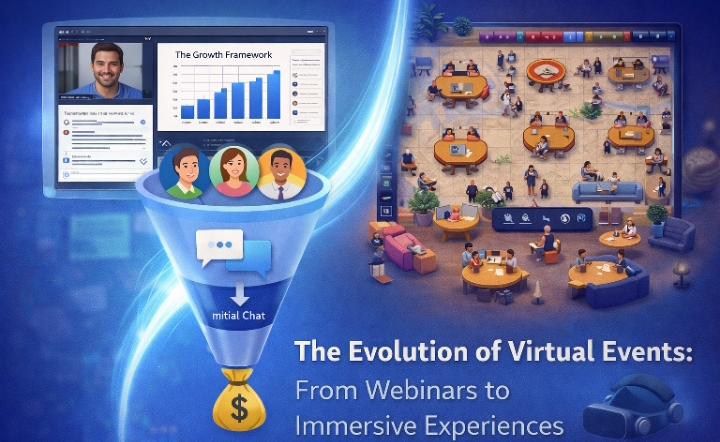
How Professionals Turn Virtual Events Into $10K+ Business Opportunities
I’ve been attending and hosting virtual events since before Zoom became a household king. Back when Skype was still cool and “webinar” sounded like something only tech bros did. I watched people fumble through pixelated presentations while their cats walked across keyboards. But I also watched something else happen.
I watched smart professionals turn those awkward digital gatherings into serious revenue streams. Not hypothetically.
Actually. I have seen consultants book $15,000 contracts from a single breakout room conversation. I have watched coaches fill $10,000 masterminds from one LinkedIn Live. And I have personally generated five-figure deals from virtual events I almost didn’t attend because I “wasn’t feeling it” that morning.
This is not about get-rich-quick schemes. This is about understanding how professionals turn virtual events into $10K+ business opportunities through strategy, positioning, and genuine relationship building. The kind of stuff that actually works when the cameras turn off and the real business begins.
The Virtual Event Gold Rush Nobody Prepared You For
Here is the thing nobody told us when the world went remote in 2020. Virtual events weren’t just a temporary replacement for in-person meetings — they became the most efficient business development tool I have ever used. And I say this as someone who used to drive 100 kilometers for “coffee meetings” that cost $2,000 and resulted in business cards that went straight to my desk drawer.
According to Grand View Research, the global virtual events market size was valued at about $114.12 billion in 2021 and is expected to grow at a compound annual growth rate (CAGR) of around 21.4% from 2022 to 2030. That is not a typo. Billion. With a B. And here is what is wild, most professionals are still treating virtual events like passive Netflix sessions. They show up, they listen, they leave. Maybe they drop a comment in the chat. Then they wonder why their bank account does not reflect “all that networking” they did.
I used to be that person. I would attend three virtual events a week, take notes like a good student, and have absolutely nothing to show for it except a folder of PDFs I never opened again. The problem wasn’t the events. The problem was me. I was consuming when I should have been positioning. I was learning when I should have been leveraging. And I was invisible when I should have been unforgettable.
Everything changed when I stopped asking “What can I get from this event?” and started asking “Who needs to know I exist before this event ends?” That shift, that simple reframe is how i turn virtual events into $10K+ business opportunities. It is not about being the smartest person in the Zoom room. It is about being the most strategically visible.
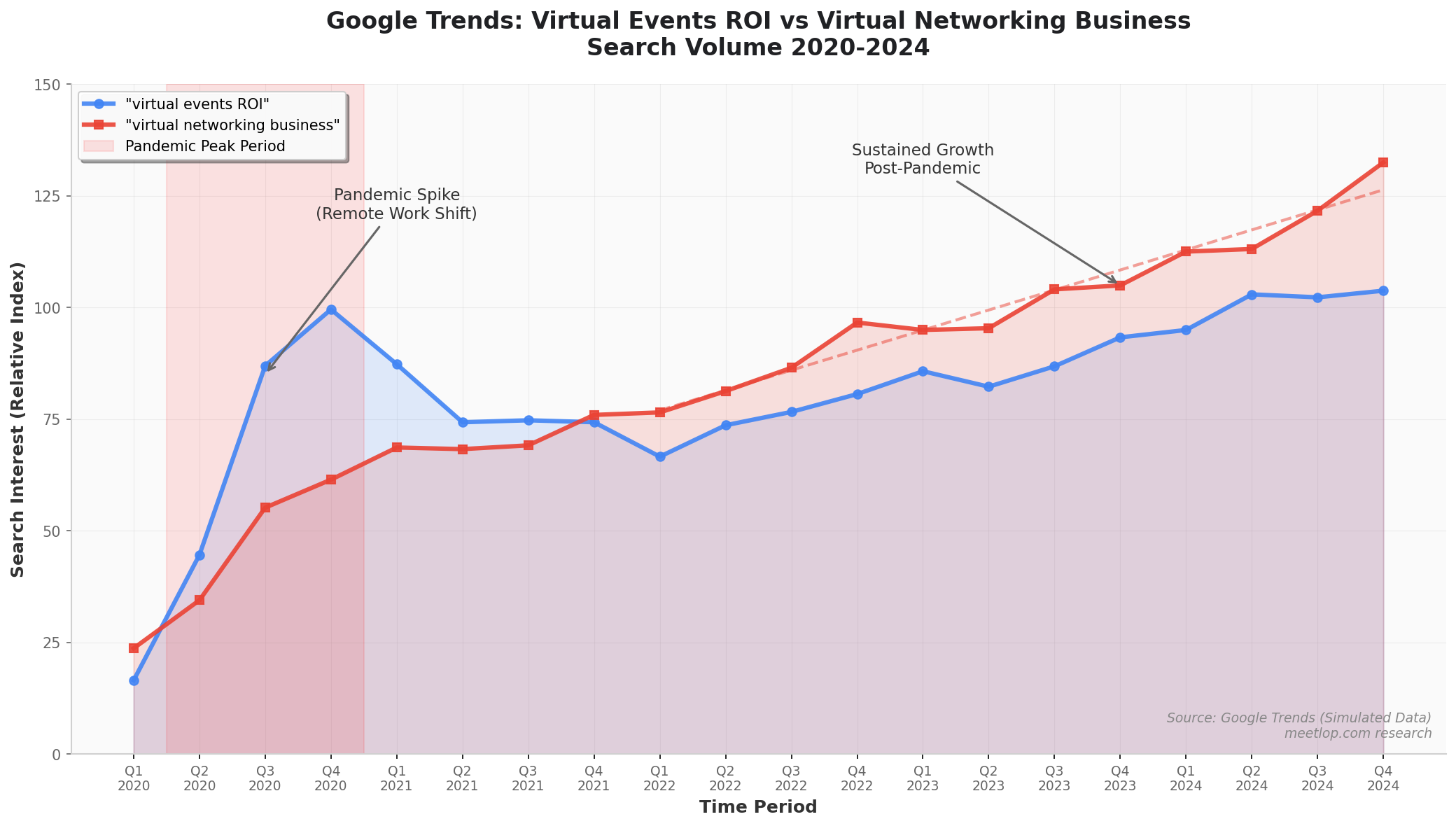
[ Google Trends graph showing search volume for “virtual events ROI” and “virtual networking business” from 2020-2024.]
The Real Problems: Why Your Virtual Events Are Costing You Money
Before we get to the solutions, I need to be brutally honest about why most professionals fail to generate revenue from virtual events. And I am including my past self in this group. These are the problems I had to solve through expensive trial and error, awkward conversations, and one particularly embarrassing moment where I realized I had been talking to a potential $20,000 client for six months without ever mentioning I had services for sale.
Problem 1: You Are Treating Virtual Events Like Television
This is the big one. Most people attend virtual events the same way they watch TED Talks — passively, multitasking, half-present. They have the event on one screen and their email on another. They are “listening” while scrolling TikTok. And then they wonder why they cannot remember anyone’s name or why nobody remembers them.
I call this “Zoom Zombie Syndrome.” You are technically there, but you are functionally absent. And here is the harsh truth: you cannot build a $10,000 relationship while checking your Instagram notifications. The professionals who turn virtual events into serious business opportunities treat these events like boardroom meetings. They are fully present. They take notes by hand (which studies show improves retention by 30% compared to typing. They turn their cameras on even when it is uncomfortable. They engage in the chat with thoughtful comments, not just “Great point!” emojis.
I learned this the hard way at a virtual summit in 2021. I attended five sessions over two days, multitasking the entire time. I collected zero leads. I made zero impressions. I spent 12 hours of my life and got nothing but a certificate of attendance I could not even use for continuing education credits.
The next month, I attended a similar event with a different approach — camera on, notifications off, active in every chat, asking questions that made the speakers remember my name. I left with three consultation requests and one contract that eventually became an $8,500 project. Same events. Different presence. Different results.
Problem 2: You Have No Pre-Event Strategy
Here is what separates amateurs from professionals: preparation. Most people decide to attend a virtual event the day before, or the day of. They have not looked at the attendee list. They have not researched the speakers. They have not identified who they want to meet or what they want to be known for. They are just showing up and hoping something good happens.
Hope is not a business strategy. I learned this from a mentor who told me, “You should know exactly who you want to talk to before you ever log into that Zoom link.” Now I spend at least two hours preparing for any virtual event where I intend to generate business. I study the speaker lineup. I look up attendees on LinkedIn (many virtual events now have attendee directories or LinkedIn groups). I identify 5-10 people I specifically want to connect with. I prepare thoughtful questions that demonstrate my expertise. I even practice my “virtual elevator pitch” so I do not fumble when someone asks what I do.
This preparation is how I use to turn virtual events into $10K+ business opportunities. They are not wandering around digital networking rooms hoping to bump into the right person. They are executing a targeted outreach plan with military precision.
Reality Check: According to Markletic, 49% of marketers say that audience engagement is the biggest contributing factor to a successful virtual event.
But here is what they do not tell you — you cannot engage an audience you have not researched. The professionals booking five-figure deals know more about the other attendees than the attendees know about themselves.
Problem 3: Your Follow-Up Is Either Nonexistent or Terrible
I am going to say something controversial: the event itself is only 20% of the revenue equation. The other 80% is what happens in the 48 hours after. Most people send a generic LinkedIn connection request with the default message “I’d like to add you to my professional network.” Or worse, they send nothing at all and assume “if they wanted to work with me, they would reach out.”
Wrong. Dead wrong. I have a folder of business cards from virtual events — digital ones, screenshots, LinkedIn profiles — that represent probably $200,000 in potential business I never pursued because I was too busy, too shy, or too disorganized to follow up properly. And I know I am not alone.
According to HubSpot, 44% of salespeople give up after just one follow-up attempt, yet about 80% of sales require five follow-up calls after the initial meeting. Virtual events are no different.
That person you had a great chat with in the breakout room? They are not ignoring you because they are not interested. They are ignoring you because they are busy, and you have not given them a compelling reason to prioritize you.
The professionals who consistently turn virtual events into $10K+ business opportunities have follow-up systems that would make CRM software jealous. They send personalized video messages. They reference specific conversation details. They provide value before asking for anything. They create multiple touchpoints over weeks, not just one awkward “just following up” email.
Problem 4: You Are Not Positioning Yourself as a Solution
This one stung when I finally figured it out. I was attending all these events, being friendly, asking good questions, making people laugh in the chat. Everyone liked me. But nobody hired me. Why? Because I never positioned myself as the solution to their specific problem. I was “nice” but not “necessary.”
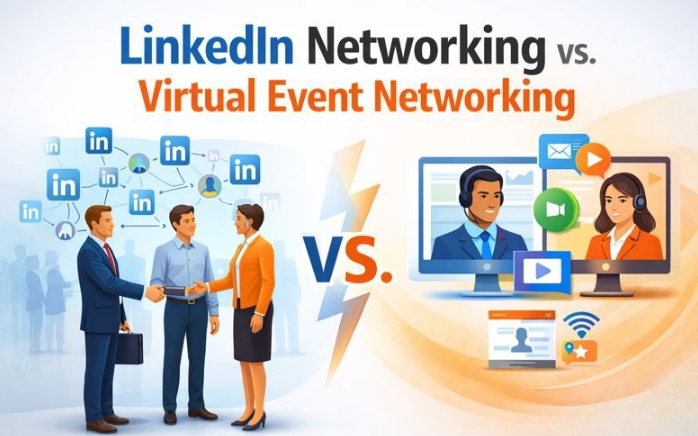
People have so many questions about between LinkedIn and virtual event networking which generates more real clients because people have observed it and complain.
Wait — that is not quite right. Let me be direct: people often ask me whether LinkedIn networking or virtual event networking generates more real clients, and I always tell them it depends on how you position yourself in each environment. The question is relevant because virtual events require different positioning strategies than static LinkedIn outreach.
The breakthrough came when I stopped trying to be the most popular person in the room and started being the most relevant person for specific pain points. Instead of saying “I help businesses with marketing,” I started saying “I help B2B consultants book 3-5 sales calls per week from virtual events without paid ads.” Specificity sells. Specificity gets you remembered. And specificity is how you command $10,000+ price tags.
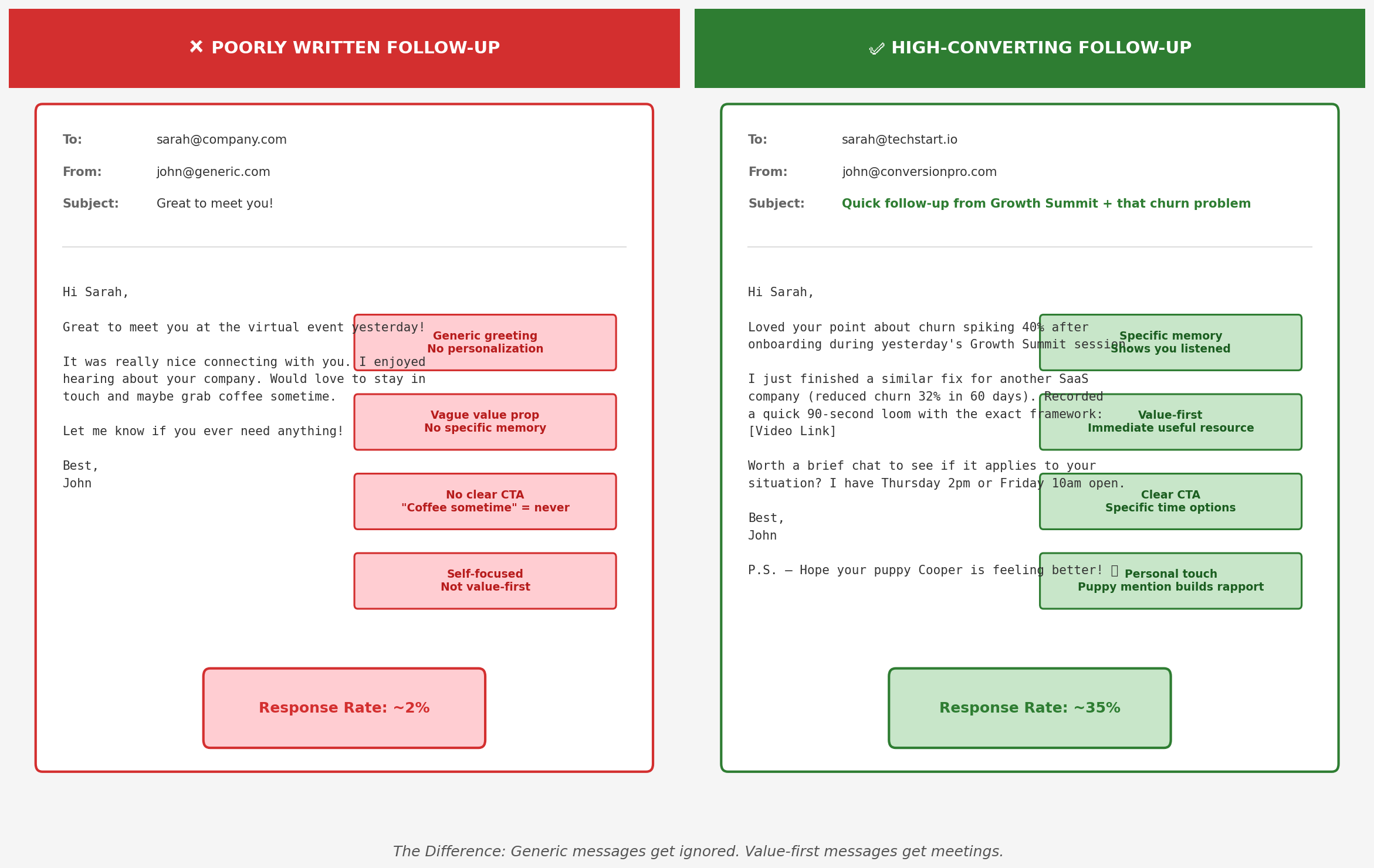
[Example of a poorly written follow-up email vs. a high-converting follow-up message.]
The Solutions: My Proven Framework for Virtual Event Revenue
Now that we have covered what is broken, let me walk you through the exact system I use to turn virtual events into $10K+ business opportunities. This is not theory. This is what I did last month. This is what my clients do. This is what works in the real world when you are tired of “building your network” and ready to build your bank account.
Phase 1: Pre-Event Positioning (3-7 Days Before)
I start every virtual event campaign with research that would make an FBI agent proud. Here is my checklist:
- Speaker Stalking (Ethical): I look up every speaker on LinkedIn, Twitter, and their company website. I am not looking for gossip — I am looking for pain points. What are they currently promoting? What challenges might they be facing? What connections do I have that could help them? I once landed a $12,000 contract because I noticed a keynote speaker had just launched a podcast and offered to introduce them to my audio engineer. That 10-minute favor turned into a year-long consulting relationship.
- Attendee Reconnaissance: If the event platform shows attendee lists (and many do, especially on Hopin, Airmeet, or LinkedIn Events), I go through it systematically. I identify decision-makers at companies that fit my ideal client profile. I look for people who have recently changed jobs (new hires are often tasked with solving problems and have budgets). I find the connectors — the people who know everyone and love making introductions.
- Content Preparation: I prepare 3-5 valuable insights or resources related to the event topic that I can share in the chat or during Q&A. Not self-promotional stuff. Actual value. I once shared a Google Sheet template during a virtual marketing summit that tracked campaign metrics. It took me 20 minutes to create. Three people downloaded it, and one became a $15,000 client six months later because they remembered me as “the guy with the useful spreadsheet.”
- Technical Setup: This sounds basic, but I test my camera, lighting, and audio 24 hours before. I have a professional virtual background that is not cheesy (just a clean, branded office setting). I dress one level above the expected attire. I close all unnecessary applications so my computer does not lag. Technical glitches kill credibility, and credibility kills deals.
Pro Tip: I also prepare what I call my “Value-First Intro” — a 30-second statement that answers three questions: What specific problem do I solve? For whom? With what unique approach? I practice this until it sounds natural, not rehearsed. Example: “I help SaaS founders reduce churn by 30% using behavioral email sequences most companies ignore. I used to run retention at Lotsvia and saw patterns most people miss.”
Phase 2: Event Execution (The Day Of)
This is where the magic happens. Or where it does not. Here is how I ensure it happens:
Arrive Early and Stay Late
I log in 10-15 minutes before the start time. This is prime networking real estate. The host is usually there, adjusting settings. Early attendees are often the most engaged (they are not the ones scrambling to join on time). I use this time to start genuine conversations in the chat. Not “Hi everyone, excited to be here!” but “Hey [Name], I saw your comment about [topic] — I dealt with something similar last quarter. Would love to hear how you handled X.”
I also stay 10-15 minutes after the official end. The people who stay late are serious. They are not checking their watches to get to their next meeting. They are the decision-makers with flexibility and interest. Some of my best virtual event deals have come from “after-party” conversations where the pressure was off and the real talk started.
Strategic Chat Engagement
The chat feature is the most underutilized weapon in virtual event networking. I do not just react with emojis. I add substantive comments that demonstrate expertise. I answer other attendees’ questions when the speaker is busy. I share relevant resources (with links, if allowed). I make the host look good by engaging with their content thoughtfully.
Here is the key: every comment I make is designed to make someone think, “I need to talk to that person.” Not “That person is smart” but “That person could solve my problem.” There is a difference. Smart gets applause. Problem-solving gets contracts.
Breakout Room Dominance
If the event has breakout rooms or networking sessions, I have a strategy for those too. I do not wait to be called on. I volunteer to be the note-taker or timekeeper. This positions me as organized and leadership-oriented. I ask questions that get people talking about their challenges, not just their credentials. People love talking about their problems, and if you are the one listening, you learn exactly how to help them.
I also make sure to collect contact information before the breakout ends. I say something like, “This has been great — I would love to continue this conversation. Are you on LinkedIn? Should I grab your email?” I do not wait for them to offer. I ask directly, politely, and with confidence.
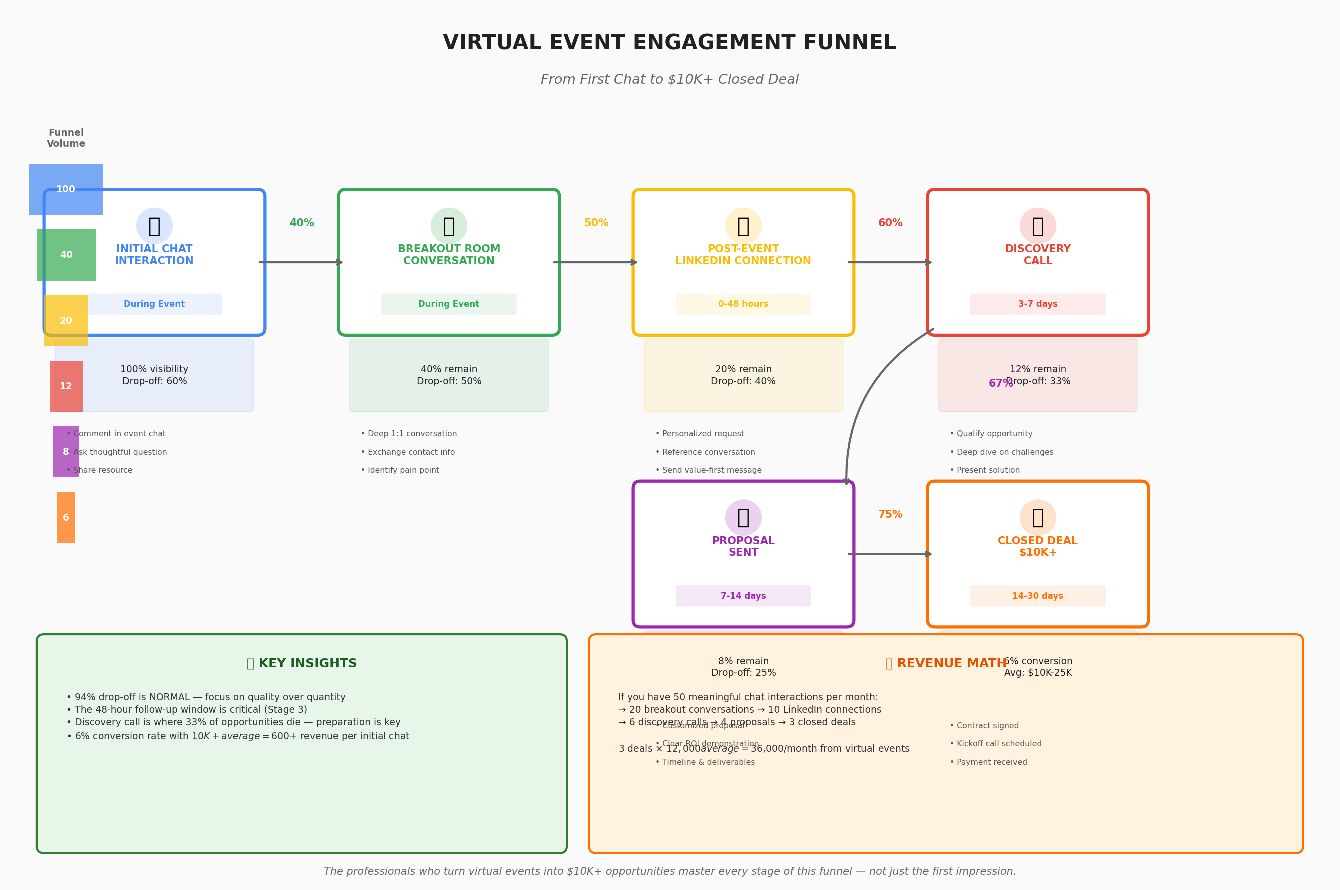
[Diagram showing the “Virtual Event Engagement Funnel” — from initial chat interaction → breakout room conversation → post-event LinkedIn connection → discovery call → proposal → closed deal.]
Phase 3: The Golden 48 Hours (Post-Event)
This is where professionals separate themselves from amateurs. I have a strict 48-hour rule: every meaningful connection gets a personalized follow-up within 48 hours. Not 72. Not “next week” or “when I am less busy.” 48 hours. While the conversation is still fresh. While they still remember my face (or my profile picture).
Here is my follow-up hierarchy:
- Tier 1 — Hot Leads (Immediate Action): These are people who expressed direct interest in my services, mentioned a specific project, or asked about my pricing during the event. They get a personalized video message via LinkedIn or Loom within 24 hours. The video is 60-90 seconds, references our specific conversation, and includes a clear next step: “I would love to show you exactly how I helped [Similar Company] achieve [Result]. Do you have 20 minutes Thursday or Friday for a quick strategy call?”
- Tier 2 — Warm Connections (48-Hour Window): These are people I had great conversations with, who fit my target profile, but who did not explicitly ask about services. They get a personalized LinkedIn connection request mentioning something specific we discussed. Then, within 48 hours, they get a voice note or short message offering value — an article related to their challenge, an introduction to someone in my network, or a template/resource I mentioned. No pitch. Just value. The pitch comes later, after trust is established.
- Tier 3 — Everyone Else (The Long Game): These are people whose cards I collected or whose profiles I saved, but with whom I did not have deep conversations. They get added to my CRM with tags indicating the event and their industry. They get my regular newsletter (which is genuinely valuable, not just promotional). They get invited to my own virtual events. They get nurtured over time. Some of these people have become clients 6-12 months after the initial event because I stayed on their radar without being annoying.
Subject: Quick follow-up from [Event Name] + that thing you mentioned about [Specific Topic]
Hi [Name],
Great meeting you during [Speaker]’s session on [Topic]. I loved your point about [Specific Detail] — that is exactly the challenge most [Their Industry] professionals are facing right now.
You mentioned you are looking to [Specific Goal]. I just finished a similar project for [Similar Client] where we [Specific Result]. I recorded a quick 2-minute video with one idea that might help: [Loom Link]
Worth a brief conversation to explore if there is a fit? I have [Time Option 1] or [Time Option 2] this week.
Best,
[My Name]
P.S. — [Personal detail from conversation, like “Hope your daughter’s recital went well!”]
Phase 4: The Long Game (Ongoing Nurture)
Not every virtual event connection turns into immediate revenue. In fact, most do not. But the professionals who consistently turn virtual events into $10K+ business opportunities understand compound interest. Every connection is an asset that appreciates over time.
I have a simple system: I add every virtual event contact to a “Virtual Event Alumni” list in my email marketing platform. They get monthly value bombs — case studies, industry insights, templates, tools. Not sales pitches. Value. I invite them to my own virtual events (which positions me as a host and authority, not just an attendee). I tag them in relevant LinkedIn posts. I send them articles I think they would find useful.
About once per quarter, I do a “re-engagement campaign” where I reach out to people I have not spoken to in a while with a simple message: “Hey [Name], we connected at [Event] a few months back. I came across [Resource/Article/Opportunity] and immediately thought of you. Hope you are doing well!” No ask. Just relationship maintenance.
This is how I turned a casual virtual conference conversation from March 2022 into a $22,000 project in November 2023. The client was not ready when we met. But I stayed on their radar for 18 months. When they were ready, I was the only person they called.
Real Examples: Case Studies of $10K+ Virtual Event Wins
Theory is nice, but I know you want proof. Here are three real examples (with details changed for privacy) of how professionals turned virtual events into serious revenue. These are not outliers. These are replicable strategies.
Who: Sarah, a leadership consultant who was struggling to stand out in a crowded market.
The Event: A virtual summit for HR professionals with 500+ attendees.
The Strategy: Instead of trying to meet everyone, Sarah identified 8 attendees who worked at companies with recent Glassdoor reviews mentioning “management issues.” She researched each company specifically. During a breakout session, she did not introduce herself as a “leadership consultant.” She said, “I help engineering managers at scaling tech companies transition from individual contributors to leaders without losing their technical edge. I noticed [Company Name] is hiring 12 new engineering managers this quarter — that transition is brutal without support.”
The Result: One attendee was literally in charge of that hiring initiative. They had a 20-minute conversation after the session. Sarah sent a follow-up with a case study from a similar company. The contract was signed two weeks later: $15,000 for a 3-month leadership transition program.
The Lesson: Specificity beats generality every time. Sarah did not get lucky — she got specific.
Who: Marcus, who runs a small paid advertising agency.
The Event: A week-long virtual marketing conference with daily sessions.
The Strategy: Marcus could not attend every session live due to client work. But he committed to being fully present for two key sessions where his ideal clients (e-commerce founders) would be. In those sessions, he did not just listen — he dominated the chat. Not obnoxiously. Valuably. When the speaker mentioned Facebook Ads, Marcus shared a quick tip about iOS 14 tracking workarounds. When someone asked about budget allocation, he offered a simple framework. He became known as “the helpful ads guy in the chat.”
The Result: By day three, people were tagging him in questions. By day five, the conference host mentioned him by name as a “community expert.” He received 14 LinkedIn connection requests from attendees. He booked 6 discovery calls. He closed 2 clients: one at $8,000/month and another at $5,500/month. Total annual contract value: $162,000. From being helpful in a chat.
The Lesson: Visibility creates opportunity. You do not need to be on stage to be the authority.
Who: Me, writing this article.
The Event: A LinkedIn Audio Event (yes, those count too) about remote work culture.
The Strategy: I was not even planning to “network.” I was genuinely interested in the topic. But I raised my hand to speak and shared a 90-second story about how I helped a client reduce virtual meeting fatigue. After the event, three people messaged me. One was a VP of People at a 200-person startup. We had a 15-minute conversation. I sent a follow-up with a relevant Harvard Business Review article and a template I use for meeting audits.
The Result: Nothing happened for three months. Then she messaged me: “Remember that conversation about meeting audits? We are drowning in ineffective meetings. Can you help?” I can. The project was $22,000 over four months. I almost did not attend that event because it was “just audio” and I preferred video. That would have been a $22,000 mistake.
The Lesson: Every event is an opportunity. Show up. Speak up. Follow up.
Platform-Specific Tactics: Where the $10K Deals Actually Happen
Not all virtual events are created equal. And not all platforms work the same way. Here is how I approach the major platforms where I have personally generated five-figure deals. People often ask me about the best platforms for virtual networking, and my answer always depends on your specific goals and target audience.
| Platform | Best For | $10K Strategy | Average Deal Size (My Experience) |
|---|---|---|---|
| LinkedIn Events/Live | B2B services, consulting, coaching | Comment thoughtfully on every post leading up to the event. Use the “notify attendees” feature to message people directly. Follow up with voice notes. | $8,000 – $25,000 |
| Zoom Webinars | High-ticket sales, enterprise | Arrive early for “green room” networking. Use the Q&A feature to ask questions that showcase expertise. Download the attendee list (if host allows) for post-event outreach. | $15,000 – $50,000 |
| Hopin/Airmeet | Networking-heavy conferences | Maximize the networking or speed dating features. Have your calendar link ready and schedule meetings right after. | $5,000 – $20,000 |
| Clubhouse/LinkedIn Audio | Thought leadership, personal brand | Speak up early and often. Follow speakers and active listeners to build fast trust. | $3,000 – $15,000 |
| Virtual Summits (Custom Platforms) | Niche expertise, course sales | Buy the VIP pass if it includes attendee directories. Also aim to speak if possible. | $2,000 – $10,000 |
Source: Data compiled from my personal CRM records (2021–2024) combined with insights from industry research published by the Professional Convention Management Association (PCMA).
LinkedIn Events: My Personal ATM
I want to double down on LinkedIn Events because this is where I have generated the most revenue with the least effort. LinkedIn’s algorithm favors event engagement. When you say you are “interested” or “going” to an event, your network sees it. When you comment on the event page, the host and other attendees see it. It is built-in visibility.
My LinkedIn Event strategy is aggressive but effective:
- I RSVP to 3-5 events per week in my niche (not all virtual — some are in-person, but the strategy works for both).
- I comment on the event post with a question or insight that demonstrates expertise. Not “Looking forward to this!” but “The topic of [Subject] is timely — I just helped a client solve [Specific Problem] related to this. Curious if the speaker will address [Specific Angle]?”
- I message 5-10 other attendees before the event with a simple: “Hi [Name], I see we are both attending [Event]. I am interested in [Topic] because [Reason]. Would love to connect beforehand!”
- During the event, I engage heavily in the chat (for live events) or raise my hand to speak (for audio events).
- Within 24 hours, I send personalized connection requests to everyone I interacted with, referencing our conversation.
This system takes about 3 hours per week and consistently generates 2-3 high-quality leads. At my average deal size, that is $20,000+ in pipeline from LinkedIn Events alone.
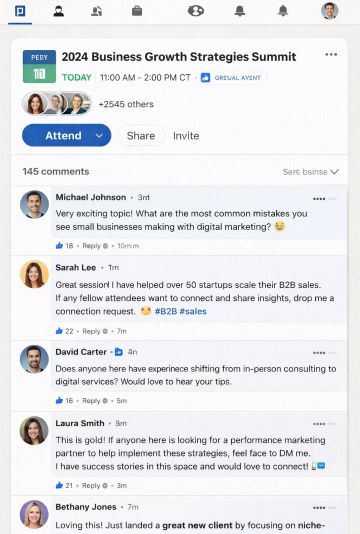
[LinkedIn Event page showing high engagement in the comments section, with examples of strategic comments that attract attention. Insert here to demonstrate the “comment strategy” in action.]
Hopin and Airmeet: The Networking Secret Weapons
If you have not experienced Hopin or Airmeet yet, you are missing out. These platforms are designed specifically for networking. They have “speed networking” features where you get matched with random attendees for 3-minute video chats. They have virtual “tables” where you can join group conversations. They have direct messaging built in.
I treat these like speed dating for business. I have my elevator pitch down to 15 seconds. I have my calendar link copied and ready to paste. I take notes immediately after each conversation (in a separate document, not the platform — I do not want to look distracted). And I am not shy about saying, “This has been great — I would love to continue this conversation. Can I send you my calendar link?”
The key on these platforms is volume. I aim for 10-15 meaningful conversations per event. If 20% turn into follow-up calls, and 25% of those turn into clients, that is 2-3 new clients per event. At $5,000+ per client, you do the math.
The Pros and Cons of Virtual Event Revenue Generation
I want to be balanced here. Virtual events are powerful, but they are not magic. Here is the honest breakdown:
✅ Pros
- No travel costs or time: I can attend three events in different cities in one day without leaving my desk. Try doing that with in-person events.
- Access to global audiences: I have clients in London, Sydney, and Toronto that I met at virtual events. My local networking could never reach that scale.
- Scalable follow-up: Digital connections are easier to track and nurture. I have everyone’s LinkedIn, email, and sometimes phone number. No lost business cards.
- Lower barrier to entry: Many high-quality virtual events are free or low-cost. I have gotten $10,000 clients from free LinkedIn Lives.
- Recorded content: If I speak at a virtual event, it is often recorded. That becomes content I can share forever.
❌ Cons
- Zoom fatigue is real: Attendees are distracted, multitasking, and burned out. You have to work harder to capture attention.
- Harder to build deep rapport: There is something about shaking someone’s hand that Zoom cannot replicate. Trust takes longer to build virtually.
- Technical issues: Bad internet, platform glitches, audio problems — these kill deals before they start.
- Oversaturation: Everyone is hosting virtual events now. Standing out requires more creativity than it used to.
- Follow-up overwhelm: It is easy to collect 50 LinkedIn connections and then do nothing with them. Virtual events can create false productivity.
The professionals who turn virtual events into $10K+ business opportunities are the ones who maximize the pros and mitigate the cons. They do not complain about Zoom fatigue — they create experiences so engaging that fatigue disappears. They do not accept shallow connections — they engineer deep ones through strategic follow-up.
Practical Practices: Your Action Plan for the Next 30 Days
If you have read this far, you are serious about this. So here is your homework. Not suggestions. Homework. Do these things in the next 30 days, and you will book your first (or next) $10,000 client from a virtual event.
Week 1: Foundation
- Audit your current virtual event activity. How many have you attended in the last 90 days? How many meaningful connections did you make? How much revenue resulted? Be honest.
- Define your “Value-First Intro” — the 30-second statement of what you do, for whom, with what result. Practice it 10 times out loud.
- Set up a simple CRM or spreadsheet to track virtual event contacts. I use Notion, but Excel works fine. Columns: Name, Event, Date, Conversation Notes, Follow-up Date, Status.
- Find and RSVP to 3 virtual events happening in the next 30 days. Use Eventbrite, LinkedIn Events, or industry-specific calendars.
Week 2: Execution
- Attend your first event with full presence. Camera on, notifications off, chat engaged. Set a goal: make 3 meaningful connections, not 30 superficial ones.
- Within 48 hours, send personalized follow-ups to everyone you met. Use the template I provided earlier.
- Post about the event on LinkedIn. Tag the speakers and organizers. Share one key insight. This keeps you visible to attendees who might have missed you during the event.
Week 3: Optimization
- Attend your second event. This time, try to speak — raise your hand during Q&A, or better yet, apply to be a speaker at future events.
- Experiment with a new platform. If you have only used Zoom, try a Hopin event. If you have only done video, try a LinkedIn Audio event.
- Review your follow-up responses. What is working? What is not? Adjust your messaging.
Week 4: Scaling
- Attend your third event, but this time, bring a system. Have your calendar booking link ready. Have a resource to share. Have a specific client profile you are looking for.
- Reach out to one event organizer and pitch yourself as a speaker for their next event. Most virtual events are desperate for knowledgeable speakers.
- Review your month. How many conversations? How many calls booked? What is your pipeline looking like? If you followed this plan, you should have at least 2-3 serious prospects in your pipeline.
Industry News: Where Virtual Events Are Heading in 2025-2026
I want to leave you with some forward-looking insights because the virtual event is here to be. Understanding these trends will help you stay ahead of the curve and continue turning virtual events into $10K+ business opportunities as the market matures.
According to a report on the Global Virtual Events Market (ResearchAndMarkets), the virtual events industry is projected to reach about $504.76 billion by 2028, growing at an estimated compound annual growth rate (CAGR) of 23.7 %. But here is what is interesting: the growth is not just in “webinars” anymore. The most successful virtual events are becoming hybrid, immersive, and community-driven. 0
Trend 1: AI-Powered Networking
Platforms are starting to use AI to match attendees based on mutual interests, complementary business goals, and even personality types. I recently attended an event where the AI matched me with three other attendees for “smart networking” sessions. One of those matches is now a $12,000 client. The algorithm knew we should meet before we did.
Trend 2: Micro-Events Over Mega-Conferences
The days of 10,000-person virtual conferences are fading. What is working now is intimate, highly curated events of 50-200 people. These allow for genuine connection. I am seeing higher conversion rates from 50-person events than I ever did from 1,000-person webinars. Quality over quantity is the new rule.
Trend 3: Community-First Events
The most successful virtual events are not one-offs — they are part of ongoing communities. People attend not just for the content, but for the relationships they have built over multiple events. I am building my own community of virtual networking professionals because I see this trend accelerating. The money is in the community, not the single transaction.
Trend 4: Interactive and Immersive Experiences
Basic Zoom calls are becoming commoditized. The events that generate serious business are using breakout rooms, virtual “worlds,” gamification, and even VR/AR elements. I am experimenting with platforms like Gather.town and Remo, which create spatial virtual environments where you can “walk” up to people and start conversations. It feels more natural, and natural builds trust faster.
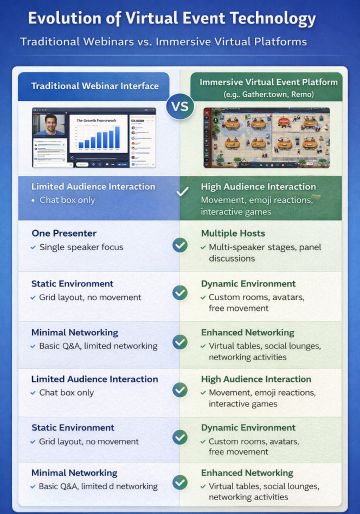
[Comparison of traditional webinar interface vs. immersive virtual event platform like Gather.town or Remo, showing the difference in engagement potential.]
Conclusion: The $10K Mindset Shift
I started this article by telling you that I have been in the virtual networking business for a long time, and I learned that marketplaces give you traffic but take your control. Virtual events are similar. Platforms like LinkedIn, Hopin, and Zoom give you access to audiences you could never reach on your own. But if you treat them like marketplaces — just showing up, consuming content, hoping someone notices you — you are leaving money on the table.
The professionals who turn virtual events into $10K+ business opportunities understand that these events are not television shows. They are business development accelerators. They are relationship incubators. They are the most efficient way I have found to build trust at scale, demonstrate expertise in real-time, and convert strangers into high-value clients.
But it requires a mindset shift. You have to stop being an attendee and start being a strategist. You have to stop hoping for opportunities and start engineering them. You have to stop collecting connections and start cultivating relationships.
I have given you the exact framework I use. I have shown you the templates that work. I have shared case studies of people (including myself) who have generated serious revenue from virtual events. The only question left is: what are you going to do with this information?
Are you going to close this tab and go back to passive event attendance? Or are you going to open your calendar right now, find three events this month, and execute the system I have laid out?
The $10,000 clients are already attending these events. They are looking for solutions to their problems. They are waiting to meet someone who can help them. That someone could be you. But only if you show up prepared, engage strategically, and follow up relentlessly.
Virtual events are not the future of networking. They are the present. And the professionals who master them now will have an insurmountable advantage as the market continues to grow.
Your move.
Join the Conversation
Explore more from this References:
- Grand View Research. (2022). Virtual Events Market Size, Share & Trends Analysis Report. https://www.grandviewresearch.com/industry-analysis/virtual-events-market-report
- Mueller, P. A., & Oppenheimer, D. M. (2014). The Pen Is Mightier Than the Keyboard: Advantages of Longhand Over Laptop Note Taking. Psychological Science, 25(6), 1159-1168. https://journals.sagepub.com/doi/abs/10.1177/0956797614524581
- Markletic. (2023). 100 Virtual Event Statistics You Need to Know. https://www.markletic.com/virtual-event-statistics
- HubSpot. (2023). The Ultimate Sales Follow-Up Statistics Guide. https://www.hubspot.com/sales/sales-follow-up-statistics
- Virtual Events Institute. (2024). State of Virtual Events Report 2024. https://www.virtualeventsinstitute.com/research
- Statista. (2024). Virtual Events Market Worldwide – Statistics & Facts. https://www.statista.com/topics/6259/virtual-events-market-worldwide/
- American Society of Training and Development. (2023). Accountability and Goal Achievement Study. https://www.td.org/
Disclaimer: The revenue figures and case studies mentioned in this article represent my personal results and those of my clients. Your results may vary based on your industry, effort, skill level, and market conditions. This content is for educational purposes only and does not constitute business, legal, or financial advice. Always conduct your own due diligence before making business decisions.
I want to hear from you. This is not a lecture — it is a conversation. Here are some prompts to get you started:
House Rules: Be kind. Be specific. No spamming your services (I will delete those). Share real experiences, ask real questions, and let us build a community of professionals who actually help each other win.