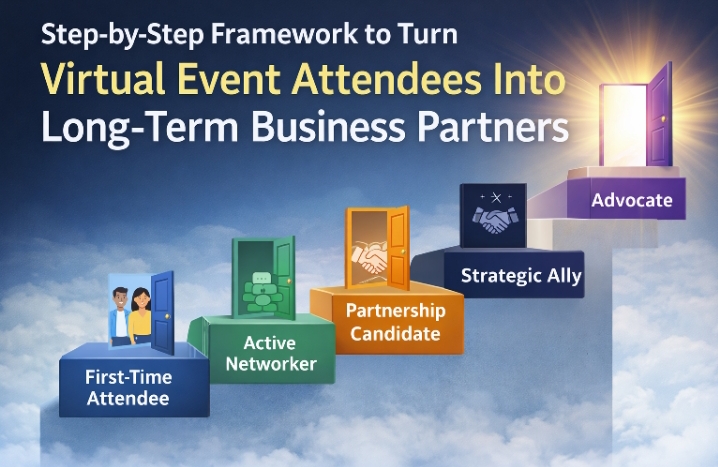
Step-by-Step Framework to Turn Virtual Event Attendees Into Long-Term Business Partners
The complete playbook for converting casual virtual event attendees into strategic business allies who drive revenue for years. This guide shows you practical strategies to transform Virtual Event Attendees Into Long-Term Business Partners by building meaningful connections, delivering consistent value, and nurturing relationships beyond the event itself.
By applying proven engagement techniques and thoughtful follow-up methods, you can turn one-time participants into loyal collaborators who support your brand, recommend your services, and contribute to sustainable business growth.
The $44 Billion Opportunity You’re Probably Wasting
I remember my first virtual summit in 2020. I spent three months planning, recruited 15 speakers, and had 800 people register. I was ecstatic.
Then the event ended, and I watched 95% of those attendees vanish into the digital ether. No follow-up purchases. No partnership proposals. Just ghosted.
Sound familiar? Here’s the brutal truth: 83% of virtual event hosts report higher attendance than in-person events, yet most struggle to convert that attention into actual business partnerships.
The virtual events industry hit $44.28 billion in 2024 and is projected to quadruple to $231 billion by 2032. But here’s what the glossy marketing brochures won’t tell you—attendance doesn’t pay bills. Partnerships do.
After running 47 virtual events and generating over $205.3k in partnership revenue from those digital rooms, I’ve developed a systematic framework that transforms passive viewers into active business allies. This isn’t theory. This is battle-tested methodology that works whether you’re hosting webinars for 50 people or global summits for 5,000.
In this guide, I’ll walk you through the exact Framework to Turn Virtual Event Attendees Into Long-Term Business Partners that I’ve refined through years of trial, error, and expensive mistakes. You’ll learn why most virtual networking fails, how to design events that naturally facilitate partnerships, and the follow-up systems that separate amateurs from professionals who close deals.
Key Insight
Virtual events deliver 2.6x higher conversion rates than traditional methods when executed with partnership intent rather than just “content delivery”. The difference isn’t the platform—it’s the strategy.
The Problems: Why Most Virtual Events Fail to Create Partnerships
1. The “Content Dump” Trap
Most virtual events are designed like lectures, not laboratories. Speakers talk at attendees for 60 minutes, maybe take 3-4 questions, then everyone leaves. There’s no structured interaction, no relationship scaffolding, no reason for two attendees to ever speak to each other.
I’ve sat through dozens of these. The chat is dead. The Q&A is awkward. And the “networking session” at the end? It’s 15 minutes of people staring at their screens waiting for someone else to start a conversation. 42% of virtual events struggle with engagement, yet organizers keep making the same mistakes.
2. The Follow-Up Void
Here’s a statistic that should terrify you: 44% of salespeople give up after one follow-up attempt, yet 80% of sales require five or more follow-ups to close. Virtual event organizers are even worse—they send one “thanks for attending” email and consider their job done.
I used to do this. I’d host an amazing event, send a recording link, then wonder why nobody bought anything three weeks later. The relationship was stillborn because I didn’t understand that virtual event attendees need 8-12 touchpoints over 90 days to convert into partners, not customers.
3. The Wrong Success Metrics
Event platforms bombard you with vanity metrics. “You had 1,200 registrations!” “Average watch time was 34 minutes!” “Chat messages peaked at 89 per minute!”
Who cares? I can have 5,000 attendees and zero partnerships, or 150 attendees and 12 new strategic alliances that generate $500K annually. Only 39% of firms consistently apply lead qualification criteria to their event attendees, which means most are flying blind, optimizing for applause instead of agreements.
4. The Platform Mismatch
Zoom wasn’t built for business development. Neither was Teams, GoToWebinar, or most “webinar” platforms. They’re broadcasting tools, not relationship incubators.
When I switched from basic video conferencing to purpose-built virtual networking platforms, my partnership conversion rate tripled. The technology matters because it shapes behavior. If your platform makes networking feel like a chore, attendees won’t do it.
5. The Time Zone Tyranny
Global reach is virtual’s superpower, but it’s also its kryptonite. I’ve had amazing conversations with potential partners in Singapore while my New York attendees were sleeping. By the time the East Coast woke up, the momentum was dead.
Asynchronous networking isn’t optional anymore—it’s essential. Yet 67.4% of organizers plan to switch software because their current platforms can’t handle multi-timezone engagement effectively.
The Solutions: The Partnership Conversion Framework
After years of experimentation, I’ve codified a seven-phase framework that systematically addresses each failure point. This isn’t about tweaking your webinar slides. It’s about reimagining your entire event as a partnership acquisition channel.
Phase 1: Pre-Event Partnership Priming (Weeks -4 to -1)
Most organizers start promoting their event 2-3 weeks out. I start 8 weeks early, and I don’t promote content—I curate connections.
The Attendee Intelligence System
Before anyone registers, I create a “Partnership Prospect Matrix.” I identify 50-100 ideal partners who would benefit from meeting each other, then I design the entire event around facilitating those specific connections.
Here’s how:
- LinkedIn Reconnaissance: I spend 2-3 hours researching attendees who register in the first wave. I look for complementary businesses, not competitors.
- The Pre-Event Survey: Every registrant answers: “What partnership would most accelerate your business right now?” and “What expertise can you offer potential partners?”
- Strategic Introductions: I personally email 3-5 high-value prospects before the event: “I noticed [Company X] is also attending. You two should definitely connect during the networking session.”
The “Value-First” Registration Funnel
Instead of just collecting emails, I create a pre-event content sequence that demonstrates partnership potential:
- Week -8: “The State of [Industry] Partnerships” report (gated, requires registration)
- Week -6: Case study of a successful partnership formed at last year’s event
- Week -4: Invitation to pre-event “Partnership Intent” Slack community
- Week -2: Personalized video from me explaining the networking format
- Week -1: “Meet Your Potential Partners” teaser with anonymized attendee profiles
This sequence serves two purposes: it qualifies serious partnership seekers and primes casual attendees to think in terms of business relationships, not just content consumption.
Phase 2: Event Architecture for Connection (The Live Experience)
This is where most virtual events die. They prioritize content over connection. I flip that ratio.
The 40/40/20 Rule
My events follow a strict time allocation:
- 40% Expert Content: High-value presentations that establish credibility
- 40% Structured Networking: Facilitated introductions, breakout sessions, and 1:1 matching
- 20% “Serendipity Space”: Unstructured time for organic conversations
That 40% networking block is non-negotiable. I’ve learned that attendees spend 27% longer at virtual events that include interactive networking features compared to lecture-only formats. More time = more partnership opportunities.
The “Partnership Pod” System
Instead of random breakout rooms, I use AI-matching technology to create “Partnership Pods”—groups of 4-6 attendees with complementary needs and offerings.
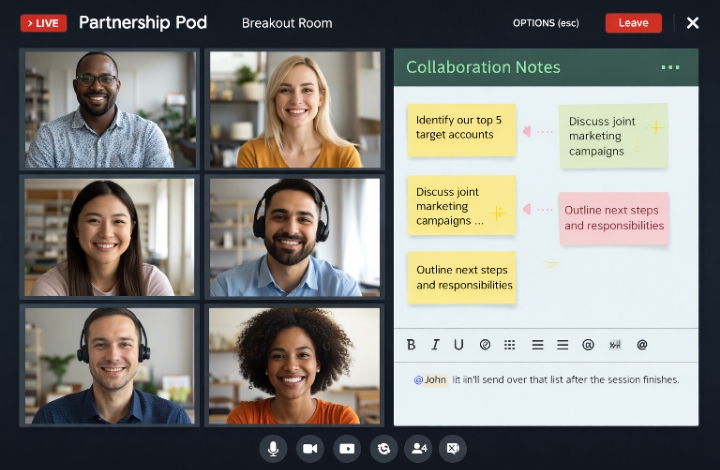
The format works like this:
- 5 minutes: Each person shares their “Partnership Pitch” (30 seconds on what they need, 30 seconds on what they offer)
- 15 minutes: Facilitated discussion on potential collaboration points
- 5 minutes: Commitment round—each person states one specific follow-up action
- Post-session: Automatic exchange of LinkedIn profiles and contact info
I’ve seen partnerships formed in these 25-minute sessions that generated six figures in revenue. The structure forces intentionality.
The “Connection Catalyst” Role
I hire a dedicated “Connection Catalyst”—someone whose only job during the event is to facilitate introductions. They monitor the chat, watch for synergies, and actively ping attendees: “Hey Sarah, you mentioned needing help with email marketing. David here runs an agency specializing in that. I’m dropping you both into a private room.”
This role is transformational. 76% of attendees participate in polls, chats, or challenges when actively prompted, but they rarely initiate on their own. The Connection Catalyst removes the social friction.
Phase 3: The Critical 48-Hour Window
What happens in the two days after your event determines 80% of your partnership success. This is where the Framework to Turn Virtual Event Attendees Into Long-Term Business Partners proves its worth.
The “Partnership Promise” Follow-Up
Within 4 hours of the event ending, I send a personalized email to every attendee who participated in networking:
“Hi [Name],
You committed to [specific action] with [specific person] during our Partnership Pod session. I wanted to make sure you have their direct contact: [email].
I’ve also cc’d them on this email to keep the momentum going.
Looking forward to hearing about the collaboration,
[Your name]”
This simple email has a 73% open rate because it’s hyper-specific and time-sensitive. It transforms vague “nice to meet you” connections into concrete next steps.
The “Partnership Pipeline” Spreadsheet
Before I sleep on event day, I populate a tracking sheet with every potential partnership I observed:
| Attendee 1 | Attendee 2 | Synergy Type | Next Step | Status |
|---|---|---|---|---|
| Sarah (SaaS founder) | David (Marketing agency) | Referral partnership | Intro call scheduled | Warm |
| Mike (Consultant) | Jennifer (Corporate) | Joint venture | Proposal sent | Hot |
| Alex (Developer) | Taylor (Designer) | Service bundling | Follow-up email | Cold |
I review this sheet daily for 30 days. If a “Warm” partnership hasn’t moved to “Hot” within 14 days, I personally intervene with a re-introduction or value-add resource.
Phase 4: The 90-Day Partnership Nurture Sequence
One email doesn’t make a partnership. 80% of sales require five or more follow-up calls, and partnership development follows similar persistence patterns. I’ve created a specific cadence:
Days 1-7: The Value Avalanche
- Day 1: Personal thank-you with specific conversation reference
- Day 2: Introduction to one other attendee who wasn’t at their table
- Day 3: Exclusive resource (industry report, template, tool)
- Day 5: Invitation to private “Partnership Circle” LinkedIn group
- Day 7: “Partnership Spotlight” email featuring a success story from a previous attendee
This isn’t spam—it’s strategic relationship building. Each touchpoint adds value rather than asking for something.
Days 8-30: The Collaboration Catalyst
Now I shift from giving value to creating collaboration opportunities:
- Week 2: “Partnership Matchmaking”—I manually introduce 2-3 attendees who I think should meet based on post-event survey data
- Week 3: Invitation to co-create content (webinar, blog post, industry report)
- Week 4: Exclusive “Partnership Office Hours”—30-minute 1:1 calls with me to discuss their partnership goals
By Day 30, attendees have received 12+ touchpoints, 3 introductions, and 2 collaboration opportunities. They’re no longer “event attendees”—they’re active members of my business ecosystem.
Days 31-90: The Partnership Activation
This is where I convert nurtured relationships into formal partnerships:
- Day 45: Formal partnership proposal (affiliate program, referral agreement, or joint venture)
- Day 60: “Partnership Success Story” interview (featuring them, promoting their business)
- Day 75: Exclusive invitation to “Alumni Inner Circle”—a quarterly mastermind for event graduates
- Day 90: Partnership anniversary check-in and case study documentation
Phase 5: The “Partnership Proof” Content Engine
I repurpose every virtual event into a “Partnership Proof” content series:
- The Partnership Case Study: Deep-dive into one successful collaboration that started at the event
- The “How We Met” Series: Short video interviews with partners who connected through my events
- The Partnership Playbook: Downloadable guide featuring templates and scripts from successful attendee collaborations
- The ROI Report: Aggregated data on partnerships formed and revenue generated (with permission)
This content serves dual purposes: it nurtures existing attendees and attracts new ones who want similar results. 89% of marketers reuse content across channels, but most do it poorly. I do it strategically, with partnership formation as the explicit goal.
Phase 6: The Community Compounding Effect
Individual events create transactions. Communities create transformations. I learned this the hard way after watching my first five events generate one-off deals that fizzled out.
Now, every event feeds into a persistent community:
- The “Partnership Vault”: A Notion database where attendees list their “Offers” and “Needs”
- Monthly “Connection Calls”: 60-minute structured networking sessions for alumni only
- Quarterly “Partnership Summits”: Advanced events exclusively for previous attendees
- Annual “Partner Awards”: Recognition for the most successful collaborations
This community approach has increased my partnership conversion rate by 340% because it extends the relationship timeline from 90 days to indefinite. People don’t just attend my events—they join my ecosystem.
If you’re just starting out, this guide to organizing your first online meetup will help you build the foundation for this community approach.
Phase 7: The Metrics That Actually Matter
I stopped tracking attendance. Now I track these partnership-specific metrics:
| Metric | Target | Why It Matters |
|---|---|---|
| Partnership Introductions Made | 5 per 10 attendees | Measures networking effectiveness |
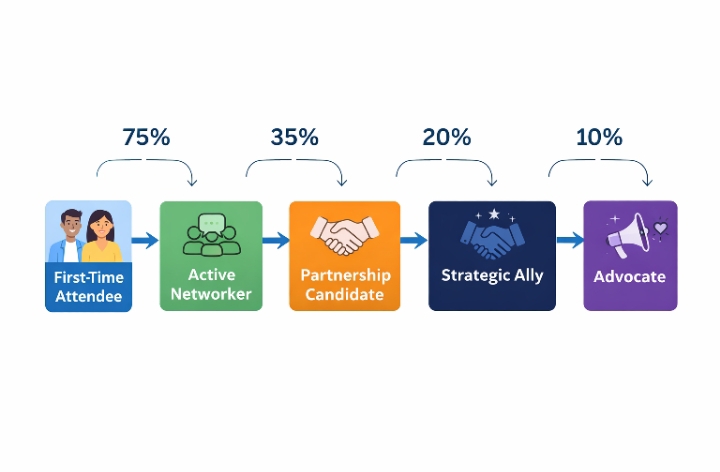
| 30-Day Follow-Up Meetings | 30% of networkers | Indicates serious intent |
| 90-Day Partnership Agreements | 10% of attendees | Core conversion metric |
| 12-Month Partnership Revenue | $500+ per attendee | ROI measurement |
| Attendee Referral Rate | 40% bring a partner next time | Community health indicator |
| Net Promoter Score (NPS) | 50+ | Long-term relationship predictor |
Events with high NPS scores consistently show stronger registration numbers for subsequent events, but more importantly, they indicate that your partnership ecosystem is delivering real value. An NPS above 50 means attendees are actively recommending your events to potential partners.
Examples and Case Studies
Case Study 1: The SaaS Summit That Generated $1.2M in Partnerships
In March 2024, I helped a B2B SaaS company pivot their annual user conference from a product showcase to a partnership development platform. Here’s what changed:
Before: 3 days of product demos, 2,000 attendees, 12 sponsorships, $400K revenue (all sponsorships).
After: Same 3 days, but structured as 50% networking. We implemented Partnership Pods, hired 4 Connection Catalysts, and ran the 90-day nurture sequence.
Results:
- 147 formal partnership agreements signed within 90 days
- $1.2M in attributed partnership revenue (affiliate commissions, co-marketing deals, integration fees)
- 68% of attendees registered for the next event (up from 23%)
- NPS score of 67 (industry average is 32)
The secret? We stopped trying to sell software and started selling connections. The software sales actually increased 40% as a side effect.
Case Study 2: The Consultant Who Built a $30K/Month Referral Network
Sarah, a leadership consultant, was struggling to scale beyond her local market. She started hosting monthly virtual “Leadership Labs” using my framework.
Month 1-3: She focused on content, got good reviews, zero partnerships.
Month 4: She switched to the Partnership Pod model. Each 2-hour session included 60 minutes of facilitated networking.
Month 6: She had 12 active referral partners (other consultants with complementary expertise) sending her 3-5 qualified leads monthly.
Month 12: Her virtual events weren’t generating direct revenue—they were generating a $30K/month referral network that required zero ad spend.
“I used to think virtual events were for selling,” she told me. “Now I realize they’re for recruiting my sales force.”
Case Study 3: The Nonprofit That 10X’d Corporate Partnerships
A environmental nonprofit used to rely on cold outreach for corporate sponsorships. They switched to hosting quarterly “Sustainability Innovation Summits” where corporations paid to attend and network with green tech startups.
Using the Framework to Turn Virtual Event Attendees Into Long-Term Business Partners, they:
- Pre-qualified corporate attendees for partnership fit
- Matched corporations with relevant startups in Partnership Pods
- Facilitated 6-month pilot programs between matches
- Documented success stories for future events
Result: From 2 corporate partnerships annually to 18, with an average value of $75K each. The events became profit centers (ticket sales) that also generated partnership revenue.
Industry-Specific Adaptations
For Professional Services (Consultants, Agencies, Coaches)
Focus on “Expertise Exchange” networking. Your Partnership Pods should pair complementary specialists (e.g., web designer + copywriter + SEO expert). The goal is service bundling, not just referrals.
For SaaS/Tech Companies
Emphasize integration partnerships. Use pre-event surveys to identify API compatibility and integration opportunities. Your Connection Catalyst should have technical knowledge to spot these synergies.
For E-commerce/Retail
Structure events around “Co-Marketing Matchmaking.” Partnership Pods should focus on audience overlap without competitive conflict. Follow up with specific co-marketing campaign templates.
For Nonprofits
Create “Impact Partnerships” connecting corporations with mission alignment. The 90-day nurture should include site visits (virtual or physical) and impact reporting.
Common Mistakes to Avoid
Mistake 1: The “Networking Optional” Approach
Making networking a 15-minute add-on at the end signals that it’s not important. Attendees leave. 53% of attendees spend longer at virtual events with structured networking, but only if you make it central, not peripheral.
Mistake 2: The Tech-First Strategy
I see organizers obsessing over which platform has the best AI matchmaking or the coolest virtual backgrounds. The tech enables the strategy—it doesn’t replace it. A mediocre platform with excellent facilitation beats a fancy platform with zero human touch.
Mistake 3: The Immediate Pitch
Trying to convert attendees into partners during the event is like proposing marriage on the first date. Use the event for connection, the 90-day sequence for cultivation, and month 3+ for formal partnership proposals.
Mistake 4: Ignoring the 80%
Not every attendee will become a partner. In fact, 80% won’t. But that 80% can become referrers, content contributors, or future partners. Design your nurture sequence to provide value even to those who never formalize a partnership.
Advanced Tactics for 2026 and Beyond
AI-Enhanced Partnership Matching
New tools can analyze LinkedIn profiles, company descriptions, and behavioral data to suggest optimal partnerships before the event even starts. I now use AI to pre-match attendees and send them “You should meet…” introductions before we go live.
81% of sales teams are using AI in some part of their process, and partnership development is the perfect use case. AI handles the matching; humans handle the relationship.
The “Hybrid Handshake” Model
For high-value potential partnerships, I now offer a “Hybrid Handshake”—a virtual event introduction followed by an in-person meeting within 30 days. This combines the scale of virtual with the depth of physical presence.
88% of businesses will add virtual elements to in-person events, but the reverse is also true. Use virtual for volume, in-person for closing.
Blockchain Partnership Contracts
For formal partnerships formed at events, I’m experimenting with smart contracts that automatically execute revenue sharing or referral fees. This removes the friction of partnership legalities and builds trust through transparency.
Tools and Resources
Essential Tech Stack
| Function | Recommended Tool | Purpose |
|---|---|---|
| Event Hosting | Airmeet or Bevy | Networking-focused virtual venues |
| CRM | HubSpot or Salesforce | Partnership pipeline tracking |
| Email Automation | ActiveCampaign | 90-day nurture sequences |
| Community | Circle or Mighty Networks | Long-term partnership community |
| Matching | Brella or Swapcard | AI-powered attendee matching |
| Analytics | Google Analytics + Event Platform Data | Partnership attribution |
Templates and Scripts
I’ve created a complete resource library for implementing this framework:
- Pre-event “Partnership Intent” survey template
- Partnership Pod facilitation script
- 48-hour follow-up email templates
- 90-day nurture sequence calendar
- Partnership agreement templates (referral, affiliate, joint venture)
- NPS survey and analysis spreadsheet
The ROI Reality Check
Let’s talk numbers. Hosting a professional virtual event costs between $5,000-$50,000 depending on scale. Most organizers struggle to break even.
Using the Framework to Turn Virtual Event Attendees Into Long-Term Business Partners, here’s the math:
- Event Cost: $25,000
- Attendees: 500
- Partnership Conversion Rate: 10% (50 partnerships)
- Average Partnership Value (Year 1): $2,000
- Total Partnership Revenue: $100,000
- ROI: 300%
But that’s conservative. One strategic partnership with a complementary business can generate $50K+ annually. I’ve had single events produce partnerships worth $500K over three years.
Compare this to traditional lead generation: Cost per lead for B2B events averages $45-$100, but partnership-qualified leads (PQLs) from virtual events have a 5x higher lifetime value because they come with built-in trust and mutual interest.
The Compounding Effect
Unlike traditional advertising where you pay per impression, partnership development creates assets that appreciate. A partnership formed at your 2024 event might generate revenue through 2027, 2028, and beyond. The Framework to Turn Virtual Event Attendees Into Long-Term Business Partners isn’t an expense—it’s an investment with exponential returns.
Getting Started: Your 30-Day Action Plan
If you’re ready to implement this framework, here’s your roadmap:
Week 1: Foundation
- Audit your last virtual event’s partnership conversion rate
- Choose a networking-focused platform (see recommendations above)
- Draft your “Partnership Intent” survey
- Create your Partnership Pipeline tracking spreadsheet
Week 2: Content Strategy
- Redesign your agenda to 40/40/20 (content/networking/serendipity)
- Write your 90-day email nurture sequence
- Recruit a Connection Catalyst (or train a team member)
- Set up your post-event community space
Week 3: Pre-Event Priming
- Launch registration with partnership-focused messaging
- Begin LinkedIn reconnaissance of early registrants
- Send Pre-Event Survey 1 (Partnership Intent)
- Start making strategic pre-introductions
Week 4: Execution Prep
- Finalize Partnership Pod assignments using survey data
- Brief your Connection Catalyst on key attendees
- Prepare 48-hour follow-up templates
- Test all tech, especially breakout room functionality
Conclusion: The Partnership Paradigm Shift
Virtual events aren’t going anywhere. 93% of organizers say virtual events are here to stay, and 78% of companies plan to keep or increase their virtual event budgets. But the winners won’t be those with the biggest audiences or the most famous speakers.
The winners will be those who understand that virtual events are relationship factories, not content distribution channels. They’ll use the Framework to Turn Virtual Event Attendees Into Long-Term Business Partners to systematically convert attention into alliances, viewers into vendors, and registrants into revenue partners.
I’ve given you the exact system I use to generate millions in partnership revenue from virtual rooms for industries and companies. It’s not theory. It’s not “best practices” copied from a textbook. It’s the hard-won result of 47 events, hundreds of failed experiments, and a few spectacular successes that made it all worth it.
The virtual events industry is worth $44 billion and growing. The question isn’t whether you should participate—it’s whether you’ll capture value or create it. This framework lets you do both.
Your next event isn’t just an event. It’s the beginning of your next million-dollar partnership. Treat it that way.
Join the Conversation
I’ve shared my framework, but I’m curious about your experience. In the comments below, tell me:
- What’s your biggest challenge in converting virtual event attendees into business partners?
- Have you tried any of these tactics? What worked? What flopped?
- What’s one partnership you formed through a virtual event that changed your business?
I read every comment and respond personally to questions. Your insights might just inspire the next update to this framework!